
Phone: +86 15398058207
E-mail: sales@astraroll.com
Add: Room 603 Building C, The Huixin Center, Zhangba One Road, Yanta Zone, Xi'an City, Shaanxi Province, China
How to Choose the Right Roller Conveyor for Your Factory
In modern factory automation and logistics systems, roller conveyors serve as the literal "backbone and lifelines" of the entire material handling process. However, when planning assembly lines or warehousing systems, many factories fail to select the correct specifications. This often leads to issues down the road, such as material jams, roller deformation, or even catastrophic electrostatic discharge (ESD) failures on sensitive components.
Choosing the wrong conveyor system means frequent downtime, high maintenance costs, and wasted efficiency. Based on proven industrial material handling standards, this guide walks you through the critical factors of roller conveyor selection to ensure a seamless, high-efficiency factory setup.
I. Core Step 1: Fully Analyze Your "Load"
Before selecting any mechanical component, you must thoroughly define the item being transported (Unit Handling).
1. Dimensions & Shape: Determining Conveyor Width & Roller Pitch
Conveyor Width: The effective width of the conveyor should be at least 50mm to 100mm wider than the maximum width of the product. This ensures safe clearance during high-speed operations.
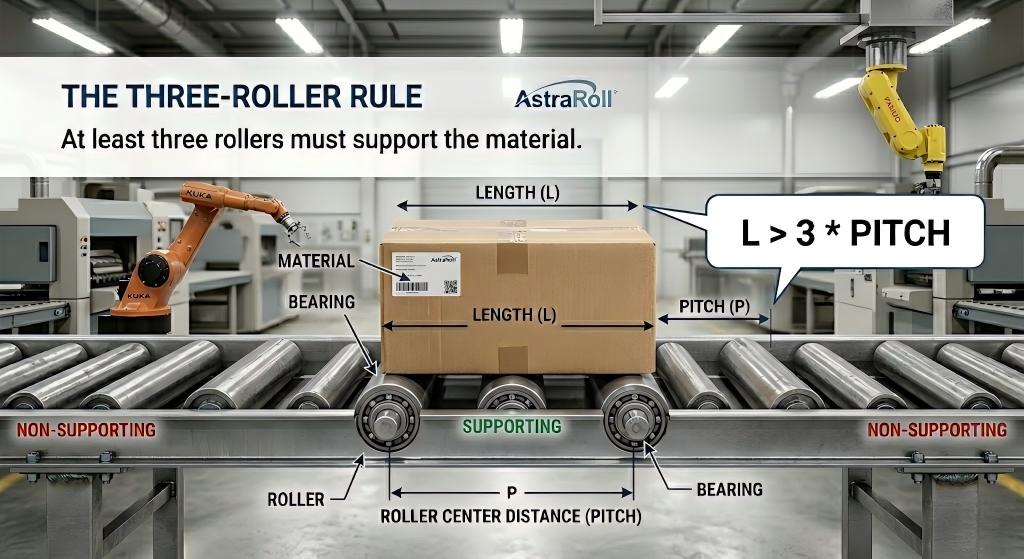
The Three-Roller Rule: To ensure smooth, stable transport without tipping or bumping, a minimum of three rollers must support the bottom of the product at all times. Consequently, the roller center distance (Pitch) must be less than 1/3 of the product's length.
2. Product Weight: Determining Single-Roller Load Capacity & Bearing Class
You must accurately calculate the maximum weight of a single product, as well as the maximum accumulated weight on the entire line during buffer or stagnation periods. This directly dictates the roller wall thickness, shaft diameter, and bearing grade.
3. Bottom Material: Hard vs. Soft Surface
Products with flat, rigid bottoms (e.g., plastic totes, wooden pallets, rigid cardboard boxes) are ideal for roller conveying.
If the items have soft, bagged, or uneven bottoms, you will need a tighter roller pitch or a specialized rubber coating on the roller surface to increase friction and stability.
II. Determine the Driving Mode: Gravity vs. Powered Conveyors
Depending on your factory's automation requirements and budget, roller conveyors fall into two main categories:
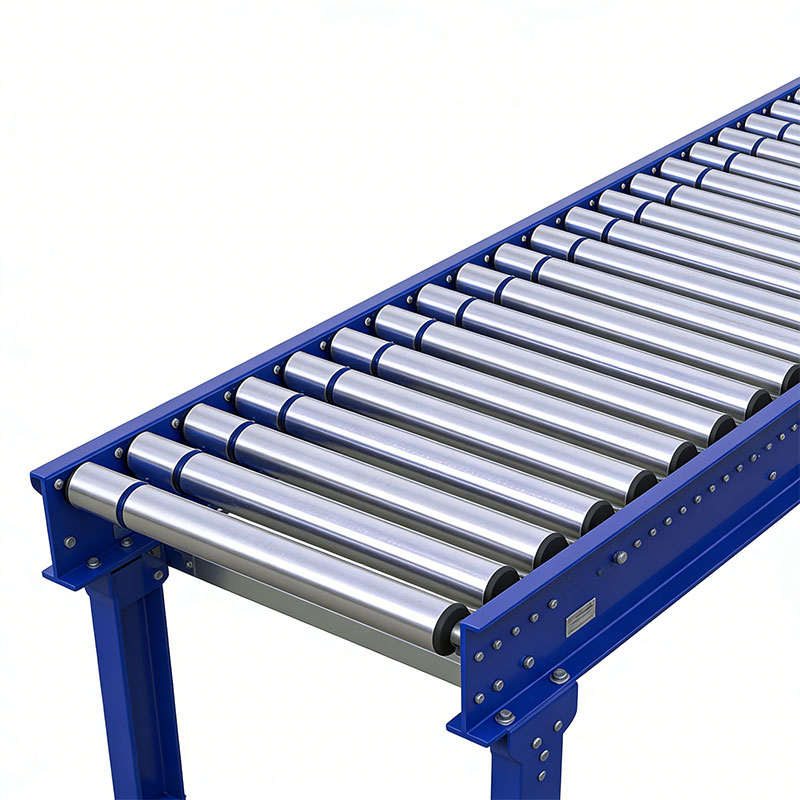
How It Works: These rely on manual push force or the conveyor’s own decline angle (typically 1.5° to 3°) to let the product slide downward using gravity.
Best Applications: Warehousing sorting zones, packaging workstations, or short-distance, light-duty transport where budget is a primary constraint.
Advantages: Exceptionally cost-effective, requires no power supply, and is virtually maintenance-free.
2. Powered / Driven Roller Conveyors
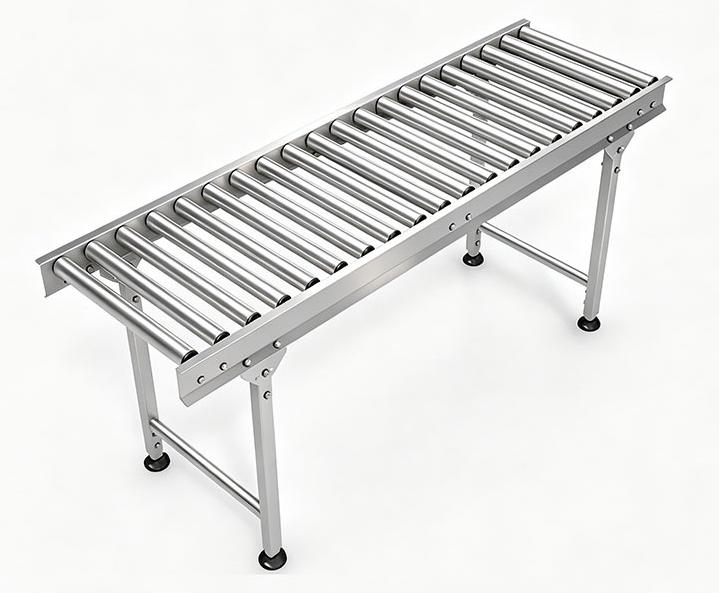
How It Works: Driven by a motor, these systems utilize chains, belts, or O-rings to rotate the rollers, enabling precise, constant-speed transportation.
Best Applications: Automated assembly lines, precision testing lines, and lithium-ion battery cell production lines where product indexing and pacing are critical.
Advantages: Fully controllable speed, supports accumulation capabilities, and is ideal for long-distance and heavy-duty transport.
III. Key Technical Specifications for Roller Selection
The rollers themselves are the primary wear-and-tear components of the conveyor. Their technical build directly determines the lifespan of your entire line.
1. Roller Diameter & Wall Thickness
Light Duty (≤50kg): Typically utilizes Ø38mm or Ø50mm rollers.
Heavy Duty (Pallets / Hundreds of kg): Requires Ø60mm, Ø76mm, or even Ø89mm heavy-duty rollers. The wall thickness must scale up accordingly (e.g., 2.0mm to 3.0mm or more) to prevent bending and structural deflection.
2. Roller Material & Surface Treatments
Zinc-Plated Carbon Steel: The most common industrial choice. It offers excellent cost-efficiency, durability, and wear resistance.
Stainless Steel (SUS304/316L): Essential for food, pharmaceutical, or washdown environments that come into regular contact with water and corrosive chemical solvents.
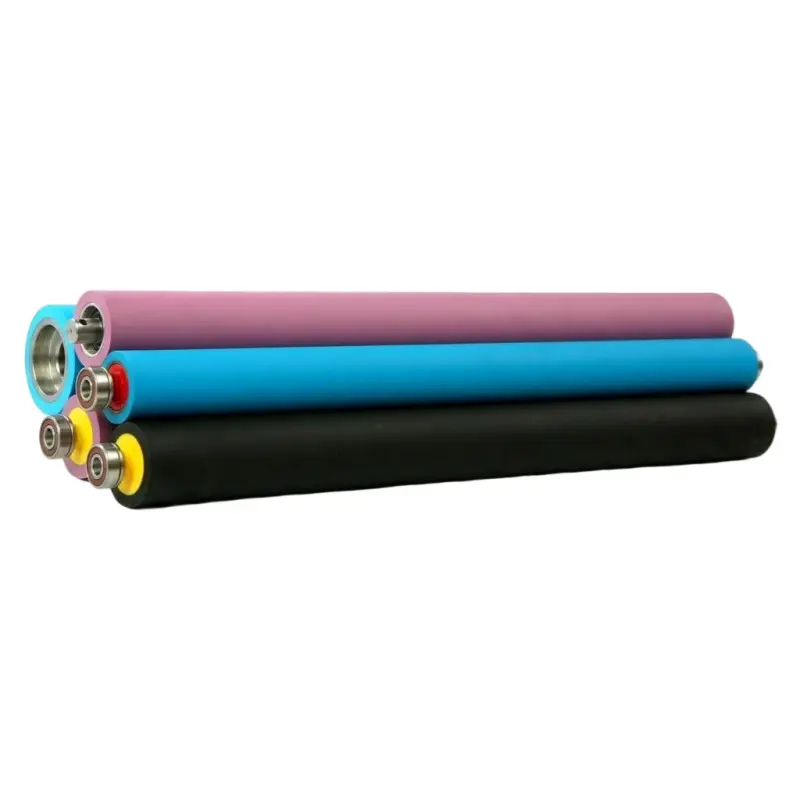
Polyurethane (PU) / Rubber Coated: Protects fragile or sensitive product surfaces (e.g., glass, polished metal plates, lithium battery electrode sheets) from scratching while significantly dampening operational noise.
3. Frame Material Selection
Aluminum Alloy Frame: Modular assembly, aesthetically clean, and lightweight. It is ideal for high-cleanliness assembly lines in the electronics and medical industries.
Powder-Coated Carbon Steel / Stainless Steel Frame: High structural rigidity, built to withstand harsh, heavy-duty logistics and warehouse environments.
IV. Evaluate Factory Environment & Specialized Process Requirements
Your specific facility environment is often the hidden factor that determines the success or failure of your system setup:
1. Electronics & Lithium Battery Manufacturing: Mandatory ESD Protection
On semiconductor (SMT) and new energy lithium-ion battery production lines, static electricity generated by friction will not only attract dust contamination but can also directly puncture microchips or ignite volatile electrode powders.
Selection Metric: Standard anti-static rollers (which rely on temporary chemical sprays that wear off) are insufficient. You must choose ESD rollers with permanent, controlled static dissipative properties (surface resistivity between 10^6 and 10^9Ω), paired with conductive bearings and frame grounding networks.
2. Extreme Temperatures & Corrosive Environments
For cold-storage warehouses, rollers must utilize low-temperature resistant lubricants. For processes involving chemical washdowns or solvent evaporation, a full stainless steel build or specialty anti-corrosion coatings are non-negotiable.
V. Product Selection
| Factory Application | Recommended Conveyor Configuration | Core Roller Technical Requirement |
| E-commerce Warehousing / Packaging Line | Gravity Type / Carbon Steel Frame | Ø50mm Zinc-Plated Carbon Steel Rollers (Highly Cost-Effective) |
| Heavy-Duty Pallet Handling / Heavy Machinery | Chain-Driven Powered Type / Heavy Steel Frame | Ø76mm+ Heavy-Duty Machined Rollers with Reinforced Wall Thickness |
| Lithium Battery Coating & Cell Transport | Belt/O-Ring Driven Accumulation / Aluminum Frame | AstraRoll Permanent ESD Dissipative Rubber-Coated Rollers with Ultra-Precise Run-out |
| Food Packaging / Pharmaceutical Cleanroom | Flat Belt Driven Type / 304 Stainless Steel Frame | Full SUS304 Stainless Steel Rollers with Waterproof/Dustproof Sealed Bearings |
VI. Conclusion: Why Choose AstraRoll as Your Conveyor System Partner?
When designing a high-efficiency factory material handling setup, choosing a high-tier roller manufacturer can save you immense time and engineering overhead. AstraRoll is committed to providing global manufacturing enterprises with industrial roller solutions that meet the highest international standards:
1:1 Advanced Customization: Whether you require precise tubing dimensions, strict run-out tolerances (≤0.01mm), or specialized surface finishes (such as hard anodizing, ceramic thermal spraying, or custom compound rubber coating), we deliver engineered solutions tailored exactly to your blueprints.
Industry-Leading ESD Engineering: For the new energy battery and high-tech electronics sectors, our ESD series rollers strictly comply with ANSI/ESD S20.20 and IEC 61340 international standards, providing permanent charge dissipation that never decays over time.
Exemplary Machining Craftsmanship: Backed by state-of-the-art CNC lathes and stringent dynamic balancing protocols, AstraRoll ensures that every single roller runs with minimal noise, low friction, and an exceptionally long service life under heavy operational loads.
Unsure which roller specification fits your factory conveyor layout?
Contact the AstraRoll technical support engineering team today to receive complete, complimentary technical assistance—from drawing evaluation to material selection!

- Anodized Aluminum Rolls vs. PTFE-Coated Aluminum Rolls: What’s the Difference?
- Steel Rolls vs. Aluminum Rolls: How to Choose the Right Roller for Your Line
- Choosing the Right Air Shaft for Web Handling
- Industrial Cleaning Brush Rollers Factory
- Industrial Brush Rollers Factory
- Three common industrial applications of brush rollers
- Is Hard Chrome Plating Enough for Stretch Rolls?
- Explosion proof electric roller