
Phone: +86 15398058207
E-mail: sales@astraroll.com
Add: Room 603 Building C, The Huixin Center, Zhangba One Road, Yanta Zone, Xi'an City, Shaanxi Province, China
What are the differences in Shore A Hardness of Rubber or PU Coated Rollers?
When engineering industrial rollers, selecting the right durometer is critical. Altering the hardness triggers a chain reaction in the roller's physical behavior, friction, load capacity, and footprint under pressure.
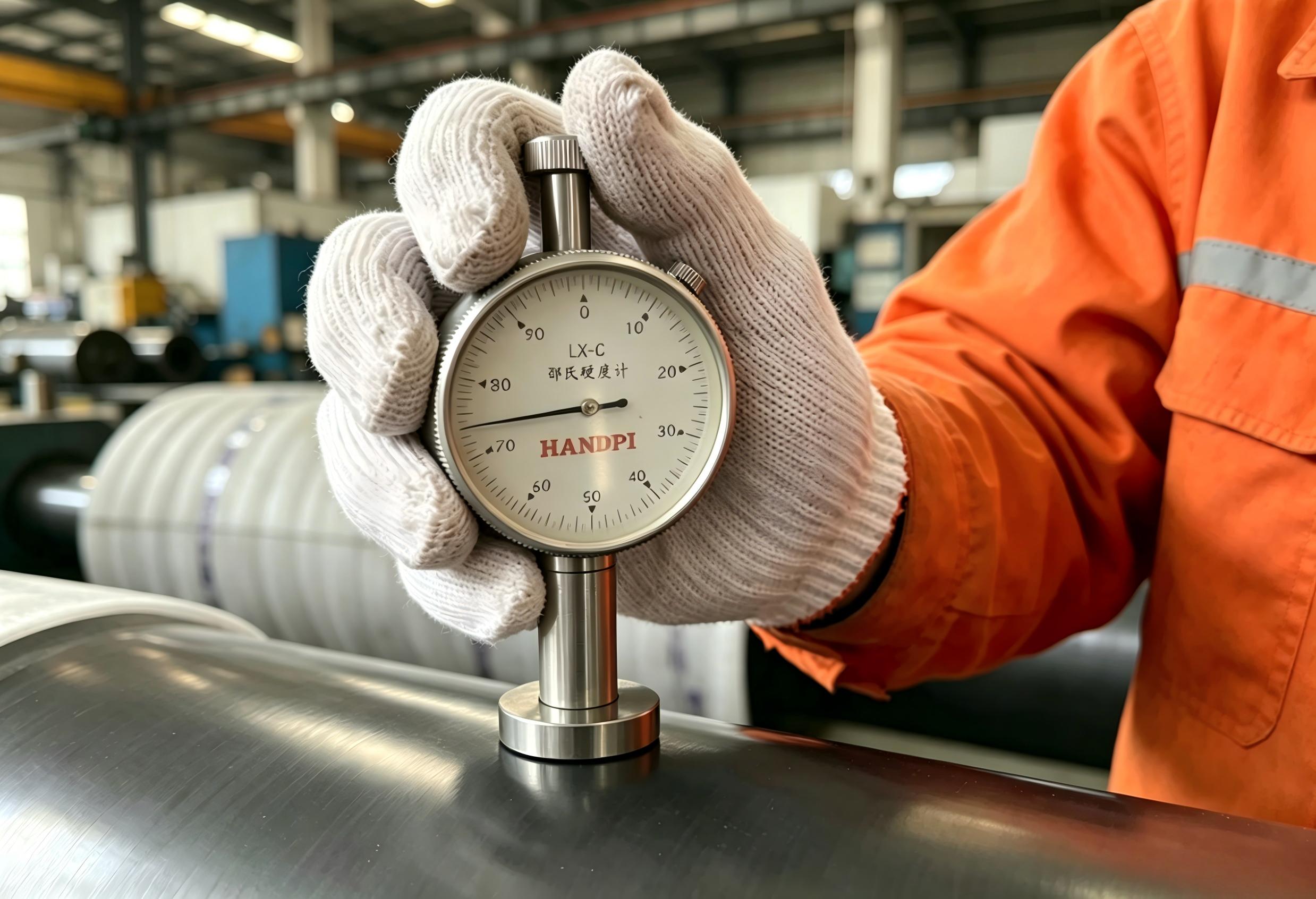
1. Key Physical Differences Across the Shore A
A. Friction and Grip
Low Hardness (20A - 50A): The elastomer surface is highly compliant. When it comes into contact with web materials or products, it deforms microscopically to provide exceptional surface friction and grip, effectively preventing material slippage.
High Hardness (80A - 95A): The surface is rigid and unyielding, resulting in a lower coefficient of friction.
B. Load-Bearing Capacity and Deflection
Low Hardness (20A - 50A): Soft rollers easily deflect (sag or deform) under heavy vertical loads. They are completely unsuited for high-tonnage or high-tension applications.
High Hardness (80A - 95A): High-durometer materials possess supreme mechanical strength. They resist deflection under heavy weight, maintaining near-perfect cylindrical geometry under intense loading.
C. Contact Area and Nip Pressure Distribution
Low Hardness: Under pressure, a soft roller creates a wide footprint or "nip zone" against the material. This spreads the clamping force across a larger surface area, offering ultra-gentle, uniform pressure ideal for sensitive web handling.
High Hardness: The nip zone is incredibly narrow, which concentrates the clamping force into a sharp, localized, and highly intense linear pressure.
D. Wear Resistance and Lifespan
Low Hardness: Soft compounds are inherently more vulnerable to scratching from sharp material edges and can suffer from premature thermal fatigue under high-frequency cycles.
High Hardness: High-durometer elastomers provide peak resistance against tearing, shearing, and abrasive wear, delivering an exceptionally long operational lifespan.
2. Recommend suitable Shore A Hardness for your industry
Different industrial manufacturing chains impose vastly distinct technical requirements on nip pressure, material sensitivity, and wear resistance. Below is an engineering selection guide for three pivotal manufacturing sectors:
A. Printing Industry — "Uniform Transfer & Delicate Nip Formations"
The core of the printing manufacturing chain (including offset, flexo, gravure, and digital proofing) relies on the flawless, uniform transfer of inks and coatings while strictly preventing delicate paper or film substrates from stretching or wrinkling.
Inking & Dampening Rollers: Recommended 25A - 40A (Ultra-Soft Range). This low durometer allows the roller to conform perfectly to the micro-contours of the printing plate, ensuring delicate ink transfer without dot loss.
Impression & Pull Rollers: Recommended 60A - 75A (Medium Range). This durometer provides optimal linear driving traction to maintain consistent web tension during long, high-speed production runs.
B. Lithium-ion Battery Manufacturing — "Extreme Pressure & Micron-Level Accuracy"
The lithium battery manufacturing chain (spanning electrode coating, calendering, slitting, and winding) is a high-value, heavy-duty, and ultra-precise environment. Rollers must deliver extreme dimensional stability and rigid support while preventing electrostatic discharge.
Electrode Coating & Laminating Rollers: Recommended 75A - 85A. This hardness ensures micron-level uniformity of the coating thickness while providing the necessary mechanical compliance to avoid puncturing or tearing fragile aluminum or copper current collectors.
Calendering & High-Tension Conveyor Rollers: Recommended 90A - 98A (Ultra-Hard Polyurethane, such as NDI systems). When electrode sheets pass through under tons of pressure, the conveyor rollers must exhibit immense resistance to compression and shearing, ensuring zero micron-level geometric deflection under extreme loads. These are often coupled with permanent ESD-safe formulations to protect active cells and line sensors.
C. Textile Industry — "High-Frequency Squeezing & Chemical Resilience"
The textile dyeing, printing, and non-woven manufacturing chains operate under continuous exposure to high humidity, elevated temperatures, and aggressive chemicals like dyes and finishing agents. Rollers here must constantly execute high-pressure dewatering and web guidance.
Padding & Squeeze Rollers: Recommended 70A - 85A. This durometer range creates the ideal nip width when fabrics pass through, applying strong, uniform pressure to squeeze out excess water or dye liquors without crushing or degrading the textile fibers.
Slitting & Guide Rollers: Recommended 60A - 70A. This range delivers balanced surface tension to prevent fabrics from mistracking, curling, or slackening along the line, while offering excellent resistance to hydrolysis and chemical corrosion.
3. Why Partner with AstraRoll?
As a premier manufacturer of high-performance rollers, AstraRoll eliminates these variables through advanced material compounding and precision machining:
Tight Durometer Tolerance: Utilizing digitized automated casting lines and computer-controlled vulcanization ovens, we eliminate localized soft or hard spots, ensuring flawless, uniform nip pressure across the entire face of the roller.
Full-Spectrum Custom Formulations: Whether you require an ultra-soft 30A silicone-coated feed roller, an ultra-durable 95A NDI-polyurethane heavy bridle roller, or specialized ESD-safe (electrostatic dissipative) high-hardness rollers for the semiconductor and battery sectors, AstraRoll manufactures to your precise blueprint requirements.
Contact the AstraRoll engineering consultation team today. Let us know your operating speeds, line tensions, and chemical environments, and we will formulate the exact Shore A hardness to optimize your equipment!

- Anodized Aluminum Rolls vs. PTFE-Coated Aluminum Rolls: What’s the Difference?
- Steel Rolls vs. Aluminum Rolls: How to Choose the Right Roller for Your Line
- Choosing the Right Air Shaft for Web Handling
- Industrial Cleaning Brush Rollers Factory
- Industrial Brush Rollers Factory
- Three common industrial applications of brush rollers
- Is Hard Chrome Plating Enough for Stretch Rolls?
- Explosion proof electric roller